
Arax 60 review by Richard de Bulat
I have owned a Kiev 60 for some years and use with both the TTL and waist level finders and I was pleased to try out the Arax version for the purpose of this review. But first thing first, let’s address a particular elephant in the room, namely, the reported issue with frame spacing which was prevalent in the Kiev 60 and may not have entirely gone away with the Arax, irrespective of any other improvements made. I have to say that I have never been particularly bothered with this issue using the Kiev, but the Arax, being new to my experience, I thought it would be worth checking it out. I used two films and two different film stocks for this review, Ilford HP5+ and Kodak Tri-x 400. With the HP5+ I loaded the camera very carelessly, taking no particular consideration of the recommended film stop, closed the camera back and wound on to the first frame. Needless to say, there were problems and I lost the first two frames and the next 4 were sitting close together, but not overlapping. The final frames were evenly spaced, but quite close together. All of the 10 frames I exposed were usable. With the Tri-x I wound on to the mark before closing the camera back and wound on to the first frame. The spacing with the Tri-x was completely different, with much wider spacing and, since Tri-x is a thicker film than HP5+, I conclude that different film stocks will behave differently. The Kiev and Arax cameras wind film with no mechanical aid to manage film spacing so different film stocks will make a thicker or thinner roll on the take-up spool. So, the lesson here is to keep the film tight as you roll on to the take up spool and set it at the right mark, in the first instance. Wind on in one, full motion until the winder stops for each new frame. If there is any problem, you can make a suitable adjustment around the mark for the first frame placement, remembering that each film stock may behave slightly differently. This is not quite the palaver that it sounds and you will soon learn to know its quirks until everything becomes second nature.
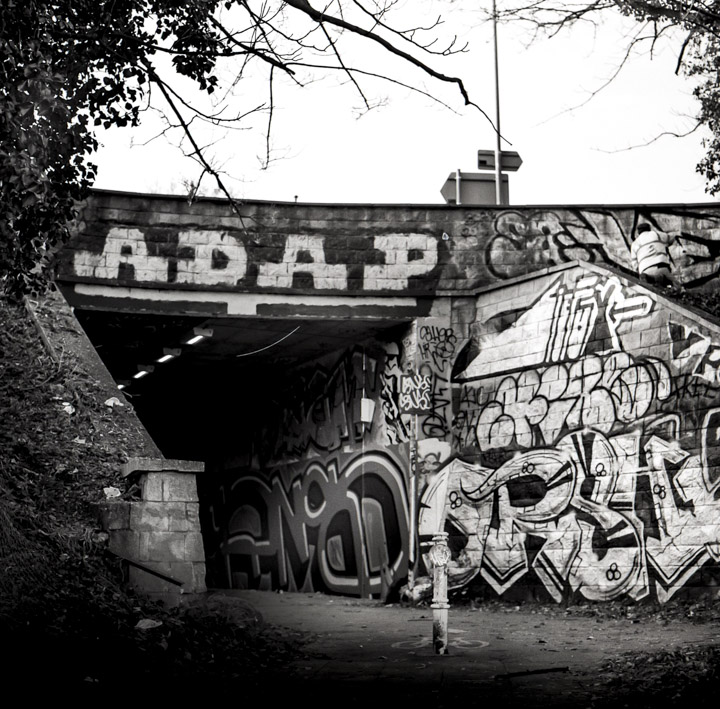
I like using this camera; I like the results, the weight and the feel of it – the whole chunky, clunky operation as well as the 6x6 format, so taking a bit of time to get it right is not a problem for me and I think it’s worth looking at what’s good about it.


With the TTL prism head you can use it like an SLR with the advantage of a medium format image that is somewhere around 58mm square. The 80mm f2.8 lens is good, sharp and contrasty, which is my definition of a good lens and contrast helps to give definition in an image. The addition of a waist-level finder provides a different perspective, albeit with a reversed view in the viewfinder, a definite aid to composition and especially good with slow shutter speeds. Hand -held shots really need to be at 1/125th of a second or higher; the combination of mirror slap and bulk means slower shutter speeds will need a tripod unless you are going for intentional camera movement.


I took the Arax out with the waist-level finder on a walk around Stonehouse Creek. The day was a mix of low sunshine and cloud. Shots towards the sun show some evidence of flaring in the lens, but not so much as to completely ruin the image. The lens handles light and shadow well, with good shadow detail where you want it and not a lot in the way of burnt-out highlights. Using the WLF meant that I had to point the camera upwards in some shots and there is not much in the way of parallax error except in the case of the college building where I made a minor adjustment. The weight of the camera is a positive in terms of handling, helping to steady a shot in order to catch action where it occurs. I did take a couple of frames, hand held, at 1/60th sec and found some slight movement that softened the image slightly, but did nothing to improve the shot particularly and all of the shots on display were taken at 1/125th sec.
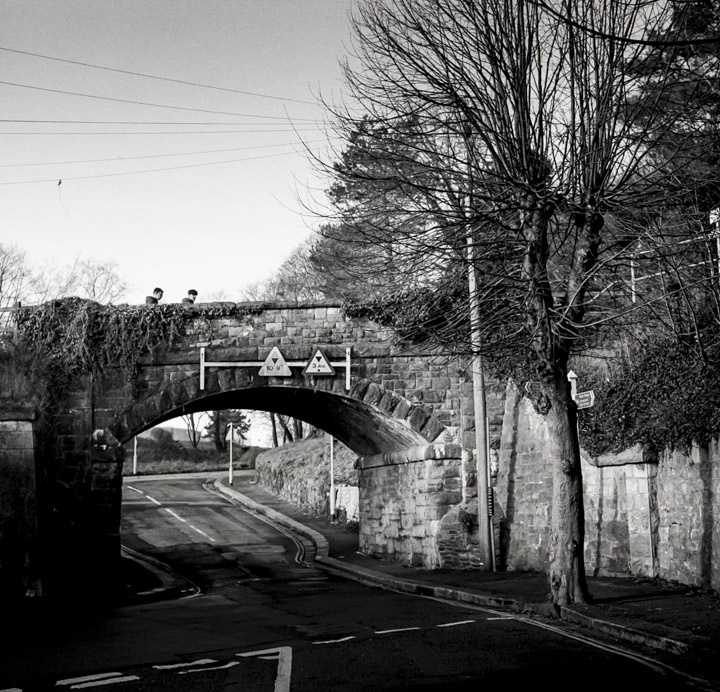
Going out for a photo session with the Arax is straight forward; it handles like an SLR with all the familiarity of an SLR; use the TTL prism and the only difference is the weight. The competition, if you can call it that, will be between this camera and a modest TLR, which has its own benefits and quirks, but the quality of the image is superior to all but the best TLR’s, in my opinion and I’ve used quite a few of them over the years. No camera suits everyone and, certainly, no camera serves every purpose. Although similar to an SLR, this is a bona fide medium format camera which is not as handy or as light as a 35mm camera, but produces an image quality few 35mm cameras can match. If you want the best in analogue medium format buy a Hasselblad, but the Arax and the image quality it can produce will not compare badly with the world’s leading cameras, so it must be worth considering.

There is no shortage of medium format cameras with a range of frame ratios; all of them have their good points as well as some limitations. I have used plenty over the years, but the ones that I choose to keep I have kept for a reason amongst which is good image quality. With the Arax camera you should expect to get a mechanically sound, medium format camera with very good image quality.


Check out our large selection of cameras for sale


