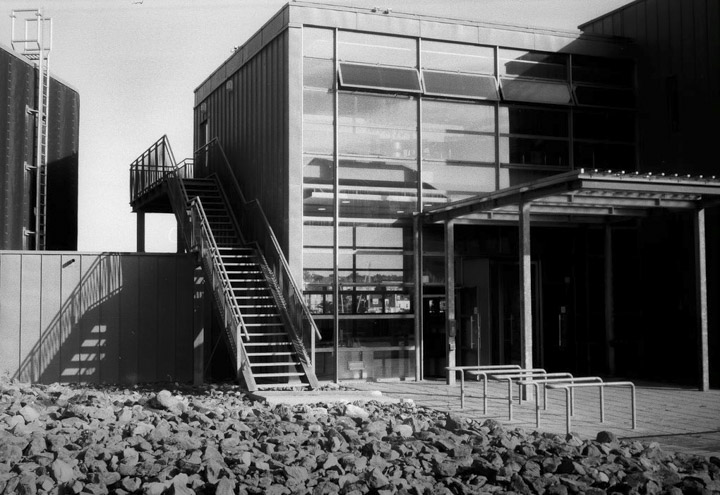
Ensign Selfix 820 review by Richard de Bulat
I went out with the Selfix 820 and a roll of Delta 400 expecting indifferent lighting conditions that turned out to be sunny one minute and cloudy the next. At the TR2 location I had strong sunlight that quite suddenly became overcast and very dull. As a result I abandoned the session but I took the camera out with me for a couple more sessions, at Marsh Mills and, for one frame only, on a circular walk. Overall, considering the different locations and situations, I think that the camera handled the different lighting conditions quite well and I developed the film normally.

I haven’t used a folding camera for a while and having this one for a few days reminded me what fun they are and what good photography practice since they are usually quite basic. Having said that, I didn’t find the camera too slow to use, more like a point and shoot but with the addition of some controls. You can shoot in either 6 x 9 or 6 x 6 formats and I chose the larger of the two which is like 35mm but with a negative that is around 6 times larger. You need to use zone focusing and tweak the aperture a little bit since not all of the shutter speeds are the same as more modern cameras. Winding on, after a shot, can be a bit of a challenge as you have to look for each frame through a red glass sight on the camera back.

The camera is getting on a bit, dating back to 1953, but it operates well, if a little stiffly in places. The lens appears to be good for the vintage and using a hand-held light meter to measure light levels, the negatives were good, without any discernible light leaks. This is a quality camera, still capable of providing good service.

Calculating depth of field can be tricky and there is a simplified formula you can follow, but nowadays you can get an app on your phone to do it for you, if d.o.f. is critical. The framing guides in the lift up viewfinder is good and can provide a good guide as to what you will get in your frame.
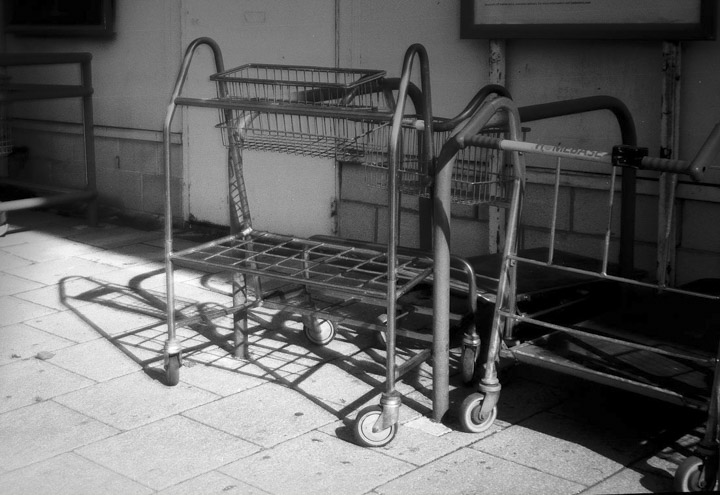
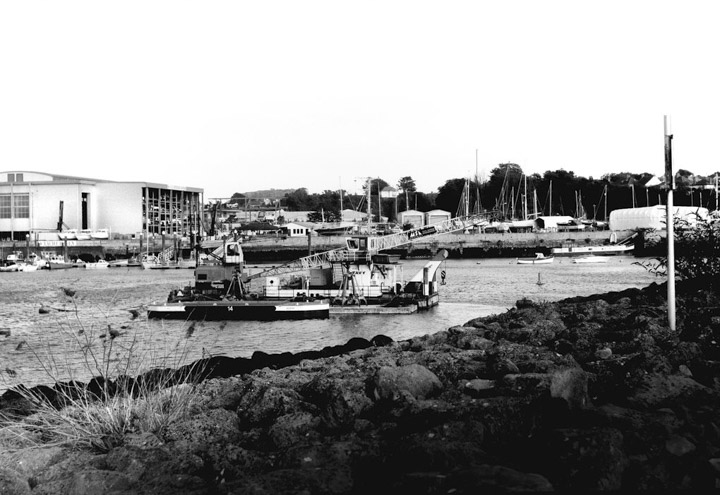
The 820 is a largish camera, but when folded up, it will fit in a coat pocket. Opening it is by means of a small button on the right of the top plate – the larger button on the left is to take the shot after you cock the shutter. Setting the distance scale on the lens, you need to consider what your nearest and furthest points of focus is going to be. On the shots where I was focusing out to infinity, I tended to set the focus ring between 25 feet and infinity to capture some of the foreground and in a couple of shots I brought that down to between 10 and fifteen feet, but didn’t try to focus any closer. I think this worked reasonably well although the results are soft in places, but that is a 70 year old camera for you. Nevertheless, all the tones between black and white are there and the image quality is really quite good.

Folding cameras are great cameras to learn analogue photography from the ground up; you have no modern sophistications to help you so you have to learn good technique. The only other camera that I can think of that gives you such a good grounding is a rangefinder although you have the advantage of a coupled focus ring and viewfinder, in that case. On the Selfix you have the benefit of a 6 x 9 negative which is enormous and capable of rendering very good detail even with high ASA rated film stock. Not so many cameras have this format and most of the ones that do are considerably more expensive, making this particular camera look like a bit of a bargain.